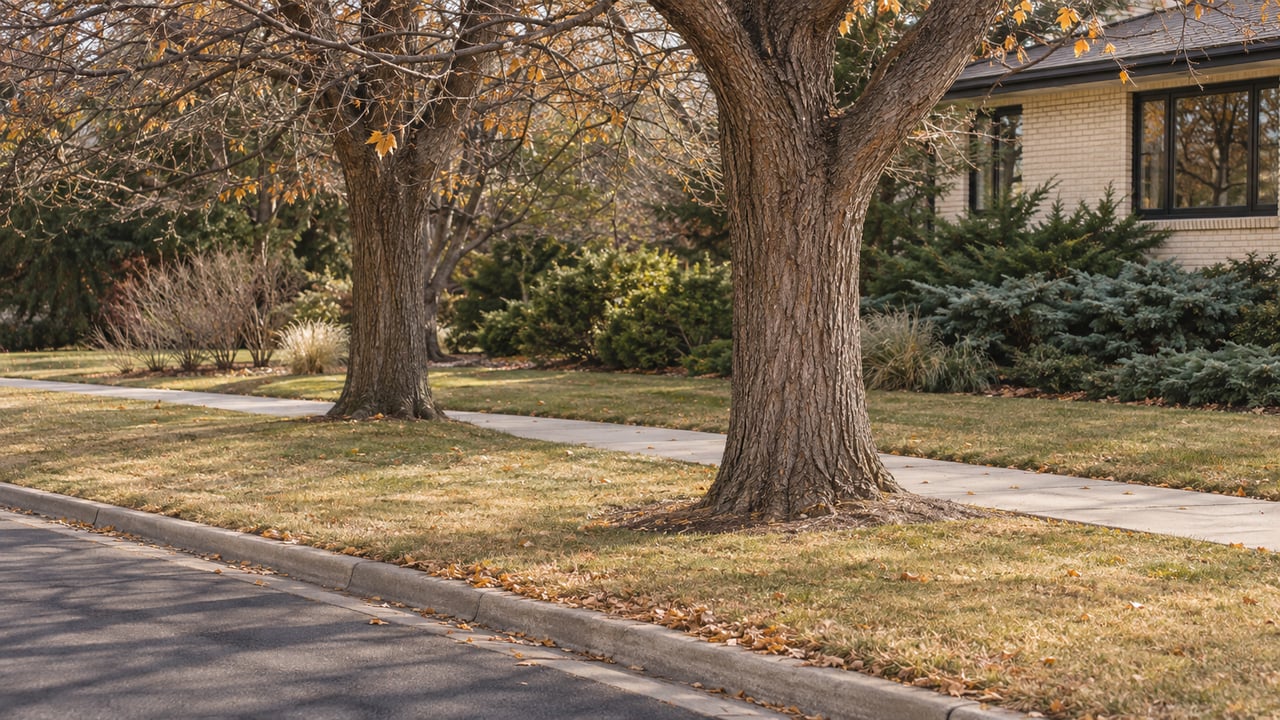
Since late 2025, crews in South Hilltop have been cutting the pavement on Cedar, Glencoe, Birch and Bayaud one block at a time. They're building the new version of a high-voltage line that has run for years under Leetsdale Drive. Xcel Energy couldn't rebuild the line where it sits, so the replacement is going in under residential streets, and some of them are in Hilltop.
The work is the Leetsdale-Monroe-Elati 230-kV Underground Transmission Line Replacement. It is a six-mile underground line through central and southeast Denver, and Xcel is replacing it with a larger, more modern cable system to meet rising demand for electricity in the area. Phase 1 covers the 2.0 miles from the Leetsdale Substation at the southeast end to the Monroe Substation to the northwest. That is the stretch running through Hilltop.
Leetsdale Was the Problem
The current line runs mostly beneath Leetsdale Drive and Speer Boulevard. Xcel says replacing it in place is ruled out for three reasons: safety risks for the public and crews in heavy traffic, the need to keep the old line energized while the new one is built, and the extra underground room the bigger cable needs. The open house boards from November 2025 put it plainly. The new line goes "away from high-traffic public roadways to safely build and maintain the line."
Xcel's routing study also avoided major collector and arterial roads to limit long-term traffic disruption and to follow city rules. It weighed traffic volumes, detours, and parking for residents and businesses. City-marked dedicated bike lanes were treated as a routing constraint as well. In Phase 1, the streets scheduled for temporary closures are East Ellsworth, South Birch, East Cedar, South Glencoe, East Dakota, South Ivy, East Virginia and South Jersey.
Here is how each of Xcel's stated requirements shows up on those blocks:
| What Xcel needed | Why Leetsdale and Speer failed it | What it means on a Hilltop block |
|---|---|---|
| Keep existing customers powered during construction | The old line had to stay live where it is | The new line needs its own route, so it goes under a different street |
| Safe construction and long-term maintenance | Heavy traffic on both thoroughfares | A route that avoids major collector and arterial roads |
| Room underground for a larger cable | Not enough space for the new system in place | Vaults and duct banks set into the residential right-of-way |
Once the new line is energized, the old line is decommissioned in place. Leetsdale keeps its old cable, out of service, and the new one runs a few blocks away under streets that were not part of the original route. The project also upgrades the Leetsdale, Monroe and Elati substations, and Xcel says the new line will support more renewable power coming into Denver.
How a Block Gets Built
The other utilities buried under each street determine how much of a block closes. In its November 2025 open house Q&A, Xcel explained why it does not leave half of each street open:
"Vault locations are dependent on the layout of existing underground utilities within the road right-of-way... we cannot guarantee placement of the vault will be on one side of the road. For this reason, we do plan to temporally close the road from both directions for the entire block."
Based on the Q&A and the project page, a block usually goes through these steps:
- Notice. Door hangers go up on homes next to the closure three to five business days before work starts. Crews from BT Construction plan to knock on doors before they begin a block.
- Closure. The block closes from both directions during work hours. Xcel's goal is one to three weeks per block, and some areas may take up to four.
- Daily hours. Xcel's project page lists Monday through Friday, 7 a.m. to 7 p.m., and Saturdays from 8 a.m. to 5 p.m. Evenings, nights or Sundays are possible in certain situations. The Q&A says crews arrive around 7:30 a.m. and that most work happens on weekdays.
- After hours. Xcel says it will shrink its footprint at the end of each day so residents can get to their garages and homes when construction hours end.
- Trash day. Xcel is coordinating with Denver Waste Collection. Crews may move bins to one side of the street for pickup and help return them afterward.
- Paving. Milling and paving run together, and paving follows milling as the work moves along. Fresh asphalt needs time to cool, so driveways and the roadway close completely for a short time. Xcel asks residents to keep cars, bikes, feet and trash bins off new asphalt until crews say it is ready.
Unmapped pipes can change any block's timeline. If crews find undocumented utilities, or if existing records are incomplete, work can stop and move to another location until an engineering fix is ready. That is why Xcel describes a block as taking one to three weeks rather than giving a set number of days.
What South Hilltop Has Seen So Far
The Hilltop Neighborhood Association told residents early that South Hilltop would be directly affected. It said to expect intermittent street and sidewalk closures, detours, and the noise of underground excavation. The association's May 1, 2026 update listed South Birch Street closed between East Cedar and East Ellsworth, and East Bayaud Avenue closed between South Clermont and South Bellaire. The Bayaud stretch is also known as the Bayaud Cycleway. For bike paths affected by the work, Xcel says the city considers safety and wayfinding when it issues right-of-way permits and may require detours.
The minutes of District 5's April 7, 2026 community cabinet record Hilltop along Cedar as the main area of District 5 affected so far. Councilwoman Sawyer asked when Holly would reopen, and Xcel estimated three weeks. An attendee at the same meeting said Xcel's email notices had been useful, timely and accurate.
Xcel's schedule updated October 29 shows how the work moves. It listed East Cedar between South Glencoe and South Fairfax from October 21 to November 11. South Glencoe was closed from Cedar to Alameda over the same weeks, then from Alameda south to East Dakota through November 16. Further south, closures on Dakota, Ivy and East Virginia were set to end by November 16. Every one of those windows was scheduled to close by mid-November, and together they show the pattern. The closures overlap in short, staggered stretches, and the work moves block by block toward Monroe. Phase 1 is scheduled to run until spring 2027.
Xcel posts updated closures every week and runs an email list for weekly construction notices, which you can join through the project email, [email protected]. The project page also carries an interactive map.
Provisions for People at Home
Xcel added an Electric Vehicle Charge Station Assistance Program, a mobile charging pilot for eligible residents who can't reach their usual home charger because of construction. Xcel asks for seven days' notice when possible, can sometimes handle shorter notice depending on site conditions and equipment, and requires a participation waiver. Requests go to the project team at (303) 716-8990 or the project email.
If you work from home and need to leave during work hours, Xcel asks you to tell the team ahead of time by email, phone, or by talking to the crew on site. It says it will accommodate access needs where it can. Xcel's contractors handle damage to private property through a claims process run by BT Construction. You can start a claim through the same email or phone line, or with personnel on site. Sidewalks are meant to stay open. If any part of one is disturbed, Xcel commits to restoring it to its pre-construction condition, including Americans with Disabilities Act standards. The broader project promises to restore work areas to pre-construction conditions.
Phase 2, from Monroe to Elati, began in August 2026 and runs until spring 2028. Its schedule updated October 29 listed closures on East 4th Avenue and Monroe Street into November, plus East 1st Avenue from November 2 to 6. The new line is scheduled to go into service in 2028. Until then, Hilltop's part of the work wraps up with Phase 1 in spring 2027, on the timeline the Hilltop Neighborhood Association gave residents from the start.
The streets carrying this line are some of the most settled in Denver, and a season of trenching changes how a home on one of them shows. If your block is on the route and you're weighing timing, staging or what a buyer will notice from the curb, Coleen Sanders can walk through it with you, street by street. Let's Connect.